


Considerations for Determining Background Levels of Combustion Byproducts in Today’s Urban/Wildfire Interface in the Western US and Canada
Executive Summary
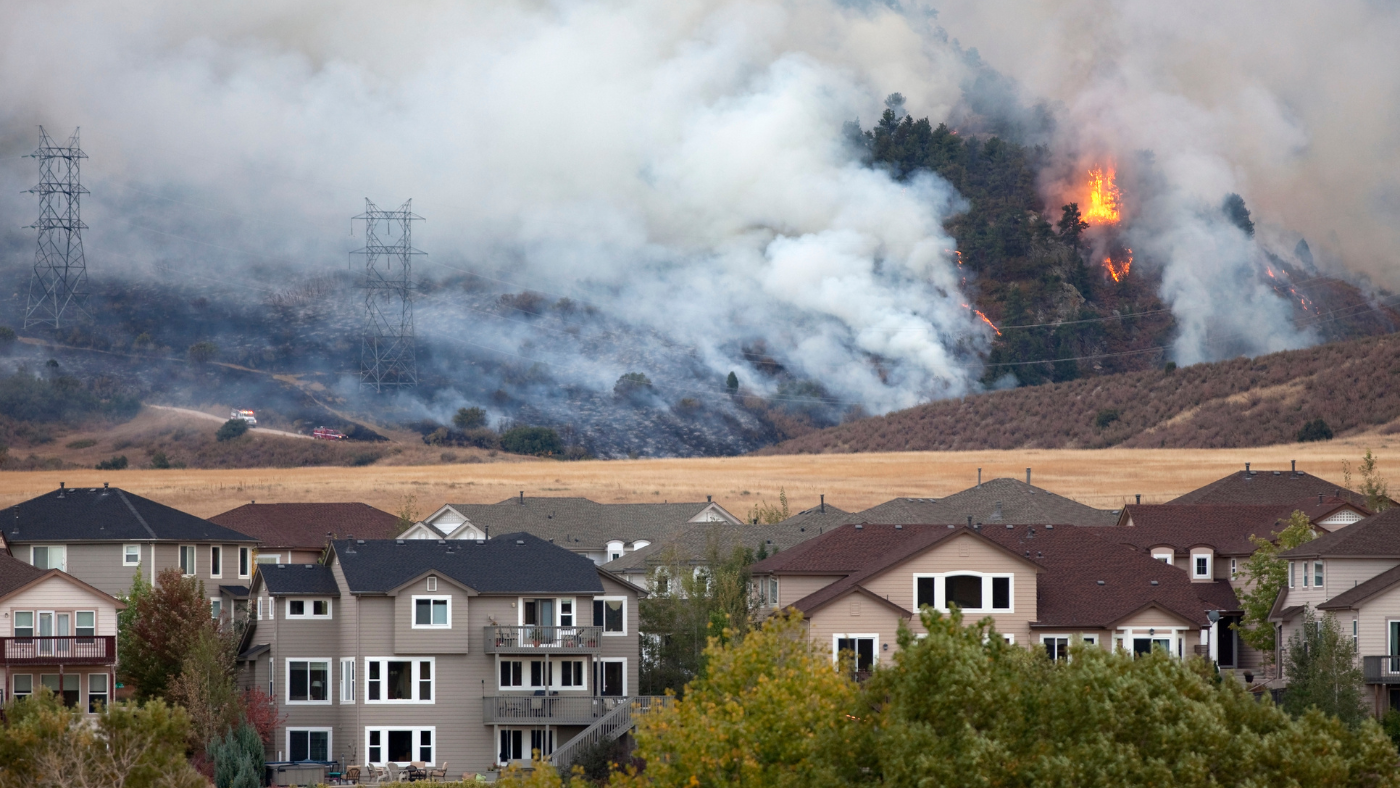
The time period from 2010 to 2026 saw increases in the number, size, and intensity of wildfires in the western United States and Canada. Many stakeholders on this issue attribute this increase, at least in part, to climate change. The combination of a changing climate and the convergence of the wildland-urban interface, or WUI, has changed the way that scientists, insurers, and property owners evaluate post-fire combustion byproduct fallout resultant from wildland/urban fires. Smoke and combustion byproducts generated in a WUI fire contain more than just burned wood and vegetation; they also contain residue from burned manmade products, including structures, vehicles, plastics, fuels, and other products. Some of these manmade products contain hazardous materials, including asbestos, heavy metals, volatile organic compounds, and polycyclic aromatic hydrocarbons (“PAHs”), among others. Some of these combustion byproduct residues are known to be human carcinogens or otherwise harmful to humans and animals.
The presence of harmful combustion byproducts in structures that remain standing after a fire present challenges to insurers, Industrial Hygienists, property owners, and restoration contractors. One of the main challenges for stakeholders is that there are currently no recognized regulatory standards with regards to post-fire assessments and cleanup or that establish acceptable standards to determine if a property has been cleaned to the point that it is acceptable to return to occupancy. Another challenge, or really question to be answered, is whether a property affected by a WUI fire can be returned to a pre-loss condition. There is a need among the stakeholders of WUI fires to determine what are considered normal or background levels of various combustion byproducts in today’s urban environments in order to establish industry-accepted post-remediation levels for a property affected by smoke from a WUI fire.
Background
The idea of climate change and the associated ramifications have been a topic of serious debate and contention over the past decade, with many varying and differing opinions among the general public, the scientific community, and politicians worldwide. However, there is one aspect of climate change that cannot be debated: the number and intensity of wildfires in the wildland-urban interface have increased in recent years. In Colorado alone, according to the Colorado Department of Fire Prevention and Control:
- 20 of the last 20 largest wildfires in Colorado history have occurred since 2002
- 17 of the top 20 largest wildfires in Colorado history have occurred since 2012
- 11 of the top 20 largest wildfires in Colorado history have occurred since 2018
- Six of the top 20 largest wildfires in Colorado history have occurred since 2020
- Four of the top five largest wildfires in Colorado history have occurred since 2020 (2020 and 2025)
Colorado’s most destructive wildfires by the number of homes lost have all occurred since 2012. Colorado most destructive wildfires by the number of homes lost are:
| Rank | Fire | Homes Lost | Year |
|---|---|---|---|
| 1 | Marshall | 1,084 | 2021 |
| 2 | Black Forest | 489 | 2013 |
| 3 | East Troublesome | 366 | 2020 |
| 4 | Waldo Canyon | 346 | 2012 |
| 5 | High Park | 259 | 2012 |
Additionally, four of Colorado’s five most destructive wildfires by acreage have occurred since 2018, and the top three of Colorado’s most destructive wildfires by acreage occurred in a single year in 2020. Colorado most destructive wildfires by acreage are:
| Rank | Fire | Acreage | Year |
|---|---|---|---|
| 1 | Cameron Peak | 208,913 | 2020 |
| 2 | East Troublesome | 193,812 | 2020 |
| 3 | Pine Gulch | 139,007 | 2020 |
| 4 | Hayman | 137,760 | 2002 |
| 5 | Lee | 137,758 | 2025 |
In California, the Palisades and Eaton fires in the greater Los Angeles area ignited on January 7, 2025, and were fueled by strong Santa Ana winds. Combined, these two wildfires burned nearly 40,000 acres, killed 29 people, and destroyed over 16,000 homes and businesses. As with many extreme wind-fueled fires, the damage from these fires was indiscriminate and unpredictable, completely burning some structures to the ground and leaving some structures partially burned or not physically burned at all but nonetheless affected by infiltrations of smoke and other combustion byproducts.
Wildfires have also been prevalent in other Western states and Canada in recent years, the smoke from which has resulted in haze and the smell of smoke in some cases hundreds of miles away. Some of the larger fires have also resulted in air quality alerts by the National Weather Service in states far removed from the fires.
The extent of areas burned by wildfires each year in the United States appears to have increased since the 1980s. According to National Interagency Fire Center data, of the 10 years with the largest acreage burned, all have occurred since 2004, including peak years in 2015 and 2020. This period coincides with many of the warmest years on record in the United States. The following from the United States National Oceanic and Atmospheric Administration (NOAA) depicts how temperatures of the earth’s surface in the United States have increased steadily from 1900 to 2020:
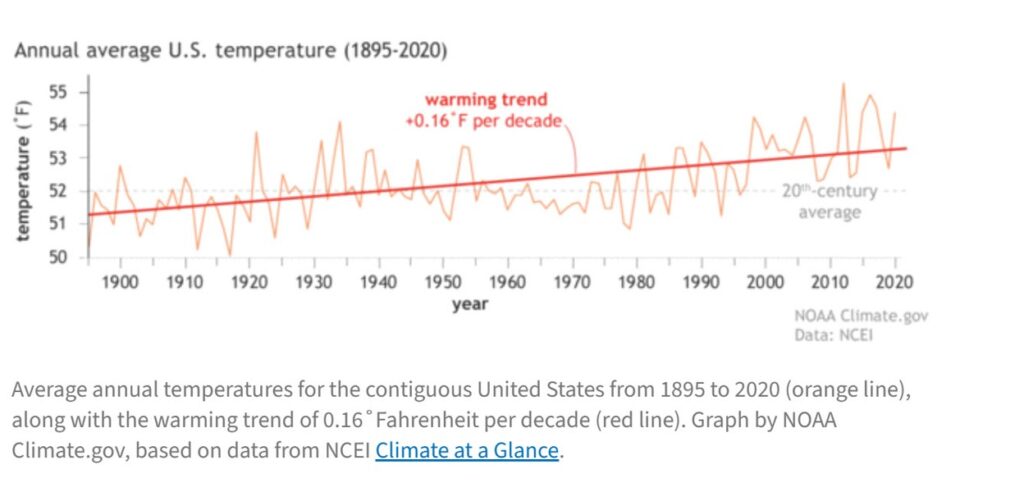
According to a white paper published by the National Academies of Sciences, Engineering, and Medicine, wildland fire activity in the United States is increasing as climate change drives more frequent extreme weather events, including heat waves and droughts. Growth in wildland fire size and intensity has also been driven by historical land management practices that emphasized fire exclusion. Fire exclusion is the deliberate act of preventing a fire in an area, regardless of whether it was natural or human caused. Simultaneously, urban development has been expanding into wilderness areas, and fires at the interface between urban and wildland areas are also increasing.
The combination of a changing climate and the convergence of the urban and wildland interface creates unique challenges when it comes to post-fire cleanup and restoration. The WUI can be conceptually defined as the area where structures and other human development meet undeveloped wildland or vegetative matter. When a wildfire intrudes into a developed community, structures, vehicles, plastics, fuels, and a myriad of other products are burned in addition to wildland vegetation. In WUI areas, the natural and man-made materials that burn in these fires emit compounds and contaminants not typically generated in wildland fires, which typically just burn vegetation. According to the American Industrial Hygiene Association’s (AIHA) Technical Guide for Wildfire Impact Assessments for OEHS Professionals, 2nd Edition, “Wildfires produce a wide range of organic chemicals, including aliphatic and aromatic hydrocarbons, PAHs, and oxygenated compounds, such as aldehydes, acids, esters, and alcohols. Many of these compounds have also been identified inside homes as part of the chemical background.”
The residues left behind after a wildland-urban fire, often termed combustion byproducts or CBPs, can contain other toxins not typically generated in a wildland fire, which is fueled primarily by vegetative matter. Some of these CBPs are known human carcinogens or known to be otherwise harmful to humans (e.g., asbestos, dioxins, etc.) and may be found in or around homes as part of the chemical background as well. These CBPs can then settle on surfaces and contents within a standing structure thereby presenting an exposure hazard to occupants, first responders, restoration/remediation contractors, and others who may enter the structures, such as insurance representatives or other tradespeople. Additionally, the presence of the CBPs in a structure, whether a single-family home, multi-family structure, or commercial structure, presents challenges to stakeholders when it comes to cleaning and restoring the property to an acceptable condition to return to occupancy. These challenges harken back to the age-old question in Environmental Health and Safety: how clean is clean?
Currently, there are no local or federal regulations or standards that pertain to post-WUI assessments, cleanup, and restoration requirements, or that establish post-remediation standards for structures or contents. The current lack of regulations or consensus standards has led to uncertainty among insurers, Industrial Hygienists, and restoration contractors with regards to performing post-fire restoration practices or contamination assessments and, more specifically, how to determine if a property has been adequately returned to as close to a pre-loss condition as possible. Further, as there are no accepted thresholds for the majority of these contaminants, the authors of this document recognize the term “post-remediation verification” as being more appropriate than “clearance standard” with regard to post-remediation efficacy. When evaluating any property, one factor that must be considered when determining acceptable levels of CBPs after remediation actions is the pre-existing levels of CBPs that were more likely than not present prior to the loss.
Anthropogenic Sources for Pre-Existing Levels of Combustion Byproducts
It must be considered that other sources of CBPs contributed to some pre-existing level of contamination when evaluating properties for possible contamination either post-fire or following remediation actions. A trained Industrial Hygienist should understand the differences between urban and rural properties, hobbies and activities of the occupants (e.g., camping, grilling, smoking food, backyard fire pits, etc.), and how the property is heated/cooled, as well as document other potential sources of contamination such as fireplaces, appliances, cooking devices, vehicles, gas and diesel-powered engines, proximity to major thoroughfares and power plants, etc. Without considering other sources and the history of a property, an Industrial Hygienist is not considering what pre-existing or baseline levels of CBPs are at a given property, and thus, may erroneously implement criteria that are biased low, providing an unrealistic remediation goal or unfair assessment of a property prior to remediation activities.
The AIHA Technical Guide to Wildfire Impact Assessments for OEHS Professionals, 2nd Edition (“the AIHA Technical Guide”), Chapter 3, states that “in a wildfire or structure fire, forensics investigation sample collection typically has two related goals. The first goal is to determine whether the particle types or concentrations, or the ratio of combustion-generated residues, indicate an atypical impact above background. If analysis shows that the particles in residues are greater than background, the second goal comes into play: to determine whether the impact defined by the assemblage of particles found is more likely to be associated with a specific fire event or with a site-specific background condition identified by the OEHS professional.”
Do Airborne Combustion Byproducts Settle Out onto Surfaces in the WUI?
In order to establish what background levels of CBPs are on surfaces and soils in today’s urban environments, it first must be determined if airborne CBPs carried in a smoke plume settle onto surfaces in urban environments. Other sources of combustion (e.g., automobile engines, etc.) are known to produce CBPs that have a recordable effect on the environment around us. This is not a revolutionary finding, either. In a 1988 article published by the National Institute of Health (NIH) titled, Ambient Levels of Anthropogenic Emissions and Their Atmospheric Transformation Products, the author notes that atmospheric concentrations of certain gases indoors and outdoors can vary based on the time of day (day vs. night) and season (summer vs. winter), and are generally highest in indoor environments. The authors of this article have performed a literary metasearch of scientific journals to determine if studies have been performed that determine or establish what background levels of CPB contaminants are in today’s urban environment. As of the time of generation of this document, the authors have not located any scientific studies that identify what expected background levels of CBP contamination may be in the WUI. In lieu of a recognized and established background level of CBPs in western urban environments, the OEHS professional must define the two related goals referenced in the AIHA Technical Guide, Chapter 3, as background levels of CBPs must be considered when performing an assessment. In other words, it is of paramount importance to acknowledge that if a pre-loss concentration of CBPs is some value greater than zero, the post-remediation efficacy criteria should consider that pre-existing value. Many of these compounds are ubiquitous, particularly in urban environments, and thus a post-remediation goal of “zero” or “none-detected” may be overly conservative, impractical, and unreasonable.
According to the Colorado Department of Public Health and Environment, “Smoke, ash, and soot after a fire can deposit particulate matter, volatile organic compounds such as benzene, and other chemicals on furniture, walls, floors, and other surfaces. Levels of chemicals inside homes that are severely smoke impacted likely will be higher than in less severely impacted homes.”
According to the California Department of Public Health, “Ash and debris from burnt structures can be blown into homes. Ash contains toxic metals and chemicals that can harm your health. It can irritate your skin, eyes, nose, and throat, make it hard to breathe, and trigger asthma attacks in people who have asthma.”
According to the California Environmental Protection Agency, “Ash from burned structures is generally more hazardous than forest ash. Fire ash contains tiny particles (dust, dirt, soot) that can be deposited on indoor and outdoor surfaces and can be inhaled if the ash becomes airborne. Although the ash is not classified as a hazardous waste, it may contain traces of hazardous substances such as metals like lead, cadmium, nickel and arsenic; asbestos from older homes or other buildings; perfluorochemicals (from degradation of non-stick cookware, for example); flame retardants; and caustic materials.”
According to the Federal Emergency Management Agency (FEMA), “When smoke from a wildfire dissipates, many of the gases are absorbed into the surrounding air and porous materials, while the particulate matter carried by the smoke settles to the ground and other surfaces as soot and ash.” While the FEMA document references wildfires as opposed to WUI fires, it stands to reason that fallout from a smoke plume of a WUI fire would also be expected to settle on surfaces.
The AIHA’s Technical Guide contains a conceptualized model of the fate and transport of wildland fire smoke based on the AIHA Technical Guide’s authors’ review of literature of wildfire impacts on air quality. According to the AIHA Technical guide, “the conceptual dispersion model is described in four stages: emission and uplift, transport, mixing, and plume deposition”. Below is Figure 1.1 from the AIHA Technical Guide wherein particle deposition from a wildfire is depicted.
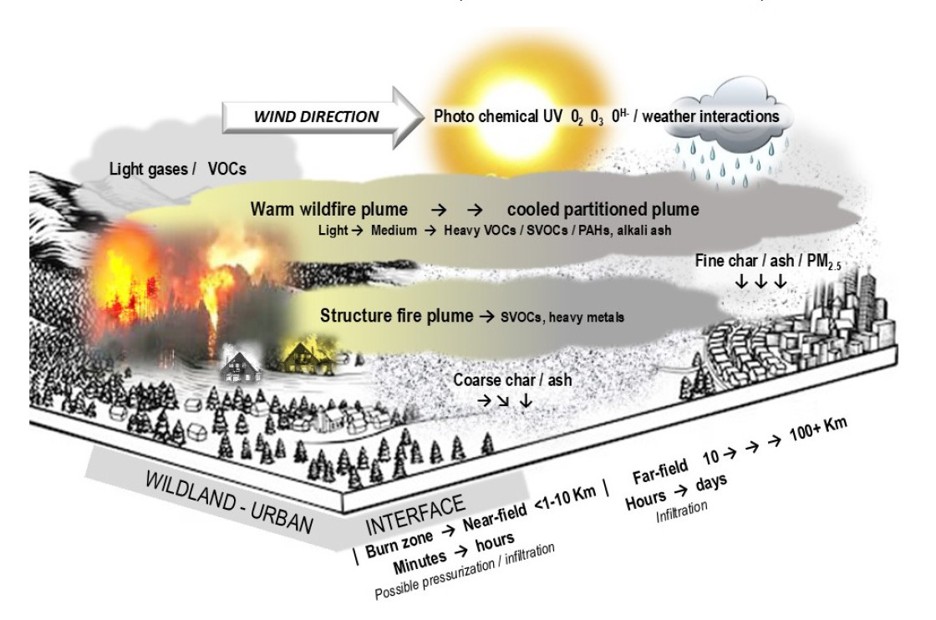
Source: AIHA Technical Guide for Wildfire Impact Assessment for the OEHS Professional – 2nd Edition
It is clear that the State of Colorado, the State of California, FEMA, and AIHA all agree that airborne CBPs in a smoke plume from a WUI fire can settle onto surfaces, thereby affecting homes and other structures in the travel path of the plume. It is also clear that these agencies are in agreement that CBP fallout can contain harmful and hazardous substances.
Based on the information presented above, it can be concluded that CBPs from a smoke plume from a WUI fire can and will settle on surfaces sometimes hundreds or even thousands of miles away. Below is an example of particulate matter from wildfires in Canada affecting the air quality in New York in the summer of 2023.
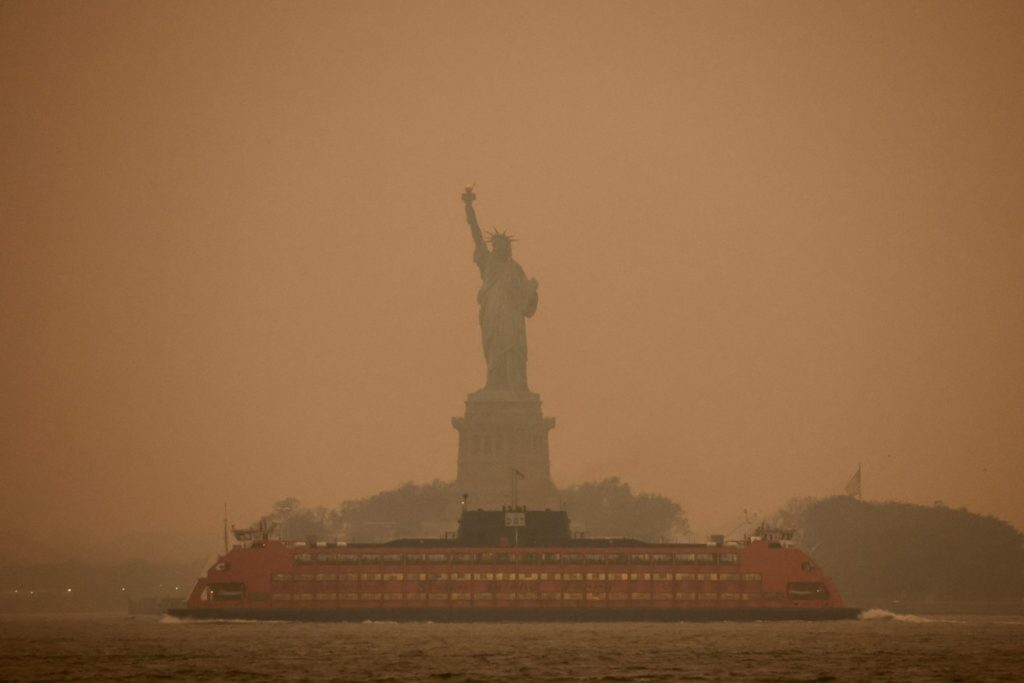
The Statue of Liberty is covered in haze and smoke caused by wildfires in Canada, in New York on June 6, 2023. Photo by Amr Alfiky/ Reuters
National Weather Service and Air Quality Reports During WUIs
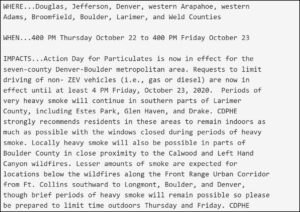
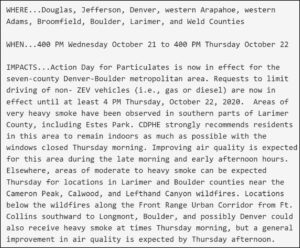
The National Weather Service (NWS) issues air quality reports based on reports from individual State Health Departments. The Iowa Environmental Mesonet (IEM), maintained by Iowa State University, contains archives of historical NWS air quality alerts. A review of historical archives on the IEM during specific WUI fire events since the year 2020 reveals numerous air quality alerts that support the idea that CBPs from smoke plumes settle on surfaces, which in turn would contribute to today’s background levels of CBPs in urban environments. Below are selected screenshots of NWS alerts for Colorado and Boulder County contained on the IEM during specific WUI fire events:
East Troublesome, Cameron Peak, Calwood, and Lefthand Canyon Fires (Colorado), August-October 2020
Camp Fire (California), 2018
According to the California Air Resources Board (CARB), “the 2018 Camp Fire was the deadliest wildfire in California history. At least 85 people died as the catastrophic wildfire burned through Butte County, destroying nearly 19,000 buildings and most of the town of Paradise. The fire generated a large plume of heavy smoke that traveled thousands of miles. The smoke caused dangerously high levels of air pollution in the Sacramento Valley and Bay Area in particular, for a period of about two weeks.” CARB conducted a study whereby they compared air quality data during the Camp Fire of 2018 to three other wildfires in 2013 that only burned vegetation and not structures. CARB found that the CBP makeup of the Camp fire was indeed different than the three wildland fires of 2013. As detailed previously herein, WUI fires are known to produce a wide variety of substances known to be harmful to humans. CARB found elevated levels of lead, zinc, calcium, and manganese during the Camp Fire and also found that “some of these metals traveled more than 150 miles, and were detected in the air as far away as San Jose and Modesto.”
According to the National Institute of Health, smoke from wildfires “can travel thousands of kilometers from its source, polluting distant communities for weeks and months. For instance, forest fires in Quebec, Canada, led to air pollution in Baltimore, Maryland, with peak PM2.5 values 17 times higher than the Environmental Protection Agency’s National Ambient Air Quality standards and to increased cardiorespiratory hospitalization rates across the mid-Atlantic and Northeastern United States.”
Summary Conclusions
The information presented herein demonstrates that wildland–urban interface fires generate combustion byproducts that are fundamentally different from those produced by wildland fires that burn vegetation alone. When structures, vehicles, plastics, fuels, and other man‑made materials are involved, the resulting CBPs include a broader and more complex mixture of contaminants, many of which are known or suspected to be harmful to human health. These differences are well documented in post‑fire air quality data and health‑based evaluations and underscore the unique challenges associated with assessing and remediating properties impacted by WUI fire smoke.
The reviewed data further shows that fine particulate matter generated during WUI fires is capable of transporting CBPs over long distances. In many documented cases, these particles have traveled hundreds of miles from the fire origin, affecting communities far removed from the burned area. As these particulates disperse, they eventually settle onto indoor and outdoor surfaces, contributing to deposition of CBPs not only near fire sites but also across broad regional extents. This long‑range transport and deposition mechanism is a critical factor when evaluating contamination potential and background conditions.
Finally, the increased frequency, size, and intensity of WUI fires since at least 2010—combined with the large number of structures and man‑made materials burned during these events—supports the conclusion that CBP deposition is now widespread throughout much of the western United States and Canada. Based on the available evidence, it is more likely than not that most urban environments in these regions exhibit pre‑existing, non‑zero background levels of CBPs that are above analytical limits of detection. Accordingly, post‑remediation evaluation criteria should account for the ubiquitous nature of these compounds and recognize that expectations of “zero” or non‑detect conditions may be impractical and technically unjustified in modern urban settings.
Continue the Conversation with Our Experts
As wildland-urban interface fires continue to reshape the built environment, Vertex’s industrial hygiene, environmental, and forensic experts provide science-based evaluations of wildfire smoke contamination, combustion byproducts, post-remediation verification, and complex insurance and litigation matters. Download the complete white paper below for an in-depth technical analysis, and connect with our team to discuss your specific project or claim.